


How to Check for Half vs Full Canvas Suits and Choose the Right Build

Updated: Oct 10
A suit can look sharp on the hanger and still hide its most important feature inside the jacket. The canvas, an inner layer usually made with horsehair, wool, cotton, or a blend, gives the front of a suit its shape. It helps the lapel roll, the chest sit cleanly, and the jacket move with the body instead of hanging like a flat shell.
If you are comparing a half canvas suit and full canvas suit construction details, high quality bespoke suit makers will usually explain the build clearly. Off the rack, made to measure, and some custom shops may not. That is where a few simple checks help.

What canvas construction means
A suit jacket has three main layers in the front:
What to look out for:
Outer wool cloth
Canvas or interlining
Inner lining
ETC.,
The outer cloth is what everyone sees. The lining is what touches the shirt. The canvas sits between them and acts like the jacket’s skeleton.
There are three common constructions:
Construction | Where the canvas sits | What it usually feels like |
Full canvas | From the shoulder and chest down through the front of the jacket | Fluid, shaped, and slightly springy |
Half canvas | Through the chest and lapel, usually stopping around the lower ribs or waist | Structured up top, lighter below |
Fused | Glue-like interlining bonded to the cloth | Flat, crisp at first, sometimes stiff |
This article focuses on how to check for Half vs Full Canvas Suits and Choose the Right Build, but knowing what fused construction feels like helps you avoid confusing the three.
How half canvas and full canvas suits differ
A full canvas suit has a floating canvas layer running down most of the jacket front. “Floating” means it is stitched in place rather than glued flat to the outer cloth. This allows the fabric to move, settle, and shape itself over time.
A half canvas suit uses canvas in the upper front of the jacket, especially the chest, shoulder, and lapel area. The lower front is usually fused or built with a lighter interlining. This gives the jacket structure where it matters most, while keeping cost and weight down.
Here is a simple visual:
Standard construction
FULL CANVAS FRONT
Shoulder [ canvas ]
Chest [ canvas ]
Waist [ canvas ]
Hem [ canvas ]
HALF CANVAS FRONT
Shoulder [ canvas ]
Chest [ canvas ]
Waist [ light interlining or fusing ]
Hem [ light interlining or fusing ]
The biggest difference shows up over time. Full canvas tends to mold more naturally to the wearer. Half canvas offers much of the same chest shape and lapel roll, but the lower front may not age with the same softness.

Step-by-step checks to identify the construction on How to Check for Half vs Full Canvas Suits and Choose the Right Build
You do not need to cut open a jacket to make an educated guess. Use these checks together, not one at a time.
1. Pinch the jacket front gently
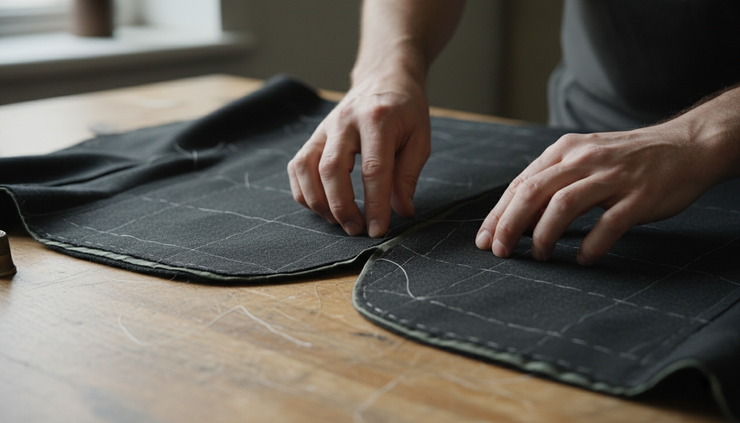
Hold the jacket near the lower front, a few inches above the hem. Pinch the outer cloth with one hand and the lining with the other.
On a full canvas jacket, you may feel a third layer moving between the cloth and lining. It will not feel glued directly to the outer fabric.
On a half canvas jacket, the upper chest may have that floating feel, but the lower front often feels flatter or more bonded.
Be gentle. Do not pull hard, especially on lightweight fabrics.
2. Test the chest area
Move your fingers to the chest, just below the lapel. Pinch again.
Both half and full canvas jackets should feel more dimensional here. You may notice padding, structure, and a slight springiness. This is why half canvas can still make a very good jacket. It places the canvas where the jacket needs shape most.
If the chest feels thin, papery, or uniformly stiff, the jacket may be fused.
3. Look at the lapel roll
Lay the jacket on a flat surface or hang it naturally. Look at the lapel from the side.
A canvassed lapel should roll softly toward the top button. It should not fold like a pressed crease.
Good lapel roll
Shoulder
\
)
/
Button
Flat lapel fold
Shoulder
\
|
|
Button
```
Full canvas and half canvas jackets can both have a good lapel roll because both usually include canvas in the lapel area.
4. Feel the lower front panel
This is where the difference becomes clearer.
Run your fingers over the lower front of the jacket, below the buttoning point. A full canvas jacket often feels consistent from chest to hem. A half canvas jacket may feel softer or thinner below the canvas endpoint, or it may feel slightly fused.
You are not looking for “better” by touch alone. You are looking for a change in structure from top to bottom.
5. Check for bubbling or rippling
Older fused jackets may bubble when the adhesive separates from the cloth. This often appears on the front panels after wear or cleaning.
Canvas construction does not rely on a broad glue bond in the same way, so it is less prone to that specific problem. A full canvas or half canvas suit can still wrinkle, but bubbling across the front is a warning sign.
6. Ask direct questions
A good salesperson or tailor should be able to answer plainly.
Ask:
Is the jacket full canvas, half canvas, or fused?
Where does the canvas end?
Is the lapel hand-padded or machine-padded?
Is the lower front fused?
Can I see a construction sample?
If the answer stays vague, keep that in mind. Whether you are shopping locally, online, or comparing claims from the best tailor in Bangkok, best bespoke tailor in town style marketing, clear construction details matter more than slogans.
Benefits of half canvas construction
Half canvas is often the best value point for many suit buyers. It gives structure where it has the most visual impact.
Key benefits include:
Strong chest shape
The jacket sits cleaner across the upper body.
Natural lapel roll
The lapel can curve instead of lying flat.
Lower cost than full canvas
It takes less labor and material.
Lighter feel
The lower front has fewer internal layers.
Good durability for regular wear
A well-made half canvas suit can last years with proper care.
Half canvas makes sense for business wear, weddings, travel suits, and wardrobes where value matters. The main tradeoff is that the lower front may not mold and drape as richly as a full canvas jacket over the long term.
Benefits of full canvas construction
Full canvas is the traditional premium build. It takes more work, but it can create a jacket with better movement and a longer life.
Its benefits include:
Better body shaping over time
The canvas adapts to the wearer with repeated wear.
More elegant drape
The front panels hang with depth rather than stiffness.
Longer useful life
With care, the jacket can keep its structure for many years.
Cleaner aging
It is less likely to show adhesive bubbling because the front is not broadly glued.
Better repair potential
Skilled tailors can often work with canvassed garments more easily.
Full canvas is ideal for a suit you plan to wear often, keep long term, or commission as a special garment. It is also a strong choice for heavier fabrics, formal suits, and bespoke tailoring where fit and longevity are the point.

Which build should you choose
Choose half canvas if you want a well-shaped jacket at a practical price. It is the smart middle ground and often the best choice for a first quality suit.
Choose full canvas if you care most about long-term fit, drape, and craftsmanship. It costs more because it takes more time to make, but the jacket can reward that investment with better movement and aging.
When checking a suit, trust the full picture. Feel the layers, study the lapel, check the lower front, and ask clear questions. A good suit should not need mystery to feel special. The better you understand the construction, the easier it becomes to choose a jacket that fits well today and still looks right years from now.


Comments